Toolshed Templates

Practical spreadsheets and guides for UK couriers, owner-drivers and small businesses. Instant download.

UK Van Cost Per Mile Calculator 2026/27: Courier and Owner Driver Job Pricing Spreadsheet (Excel, Google Sheets, PDF)

£5.99

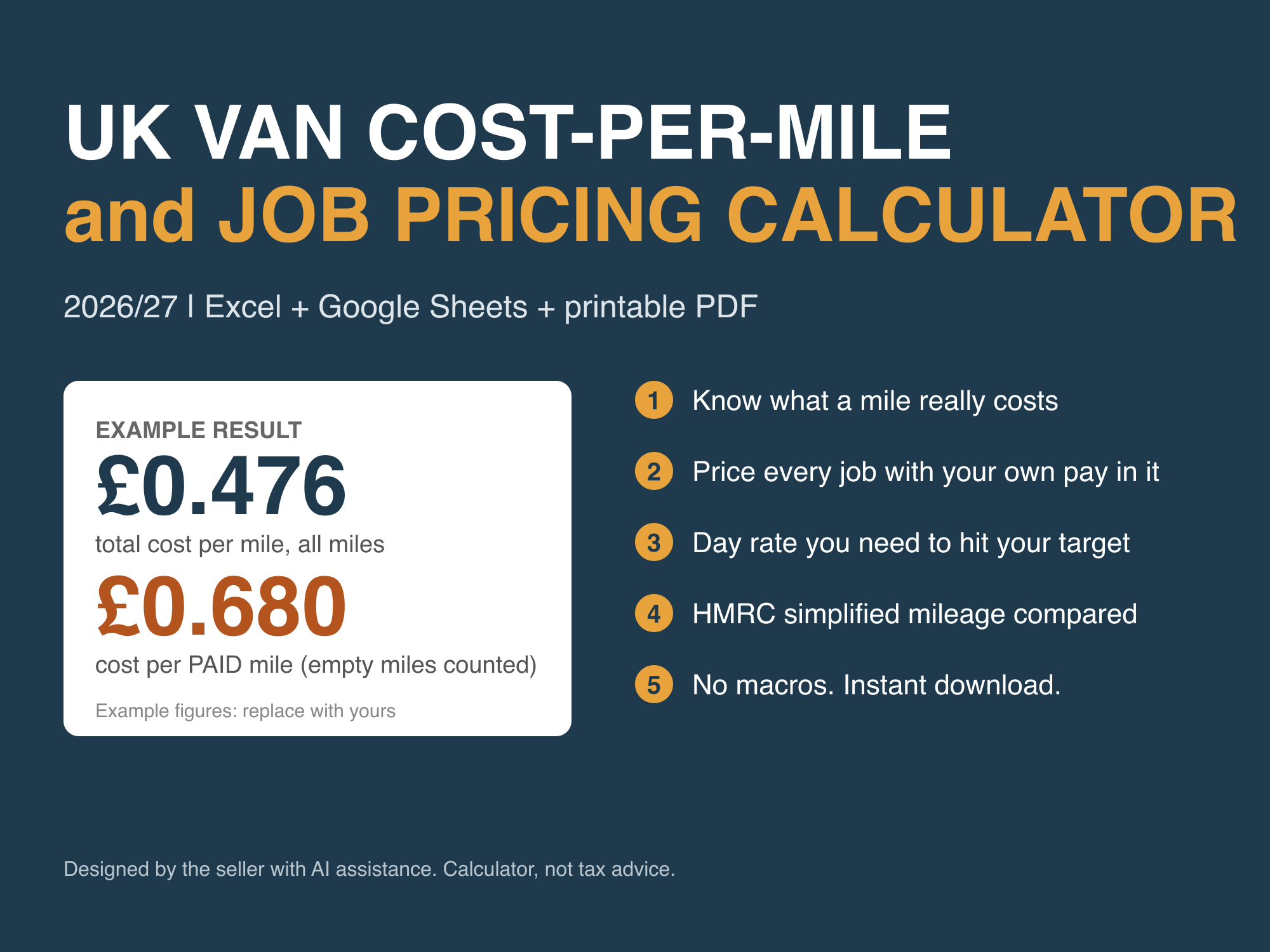
Know what every mile really costs you, then price every job so you make money.

A UK van cost-per-mile and job pricing calculator for owner-drivers, couriers, man-and-van operators and small haulage businesses. You type in your own costs. The sheet works out what a mile costs, what a PAID mile costs once your empty miles are counted, the day rate you need, and a suggested price for each job.

WHAT YOU GET (instant digital download, 2 files)
1. Excel / Google Sheets workbook with 5 tabs: Start Here, Van Costs, Day Rate, Job Pricer (20 jobs), HMRC Compare.
2. Printable PDF worksheets (5 A4 pages): a worked example, blank worksheets for your year, costs and job pricing, and an HMRC comparison page.

WHAT IT WORKS OUT
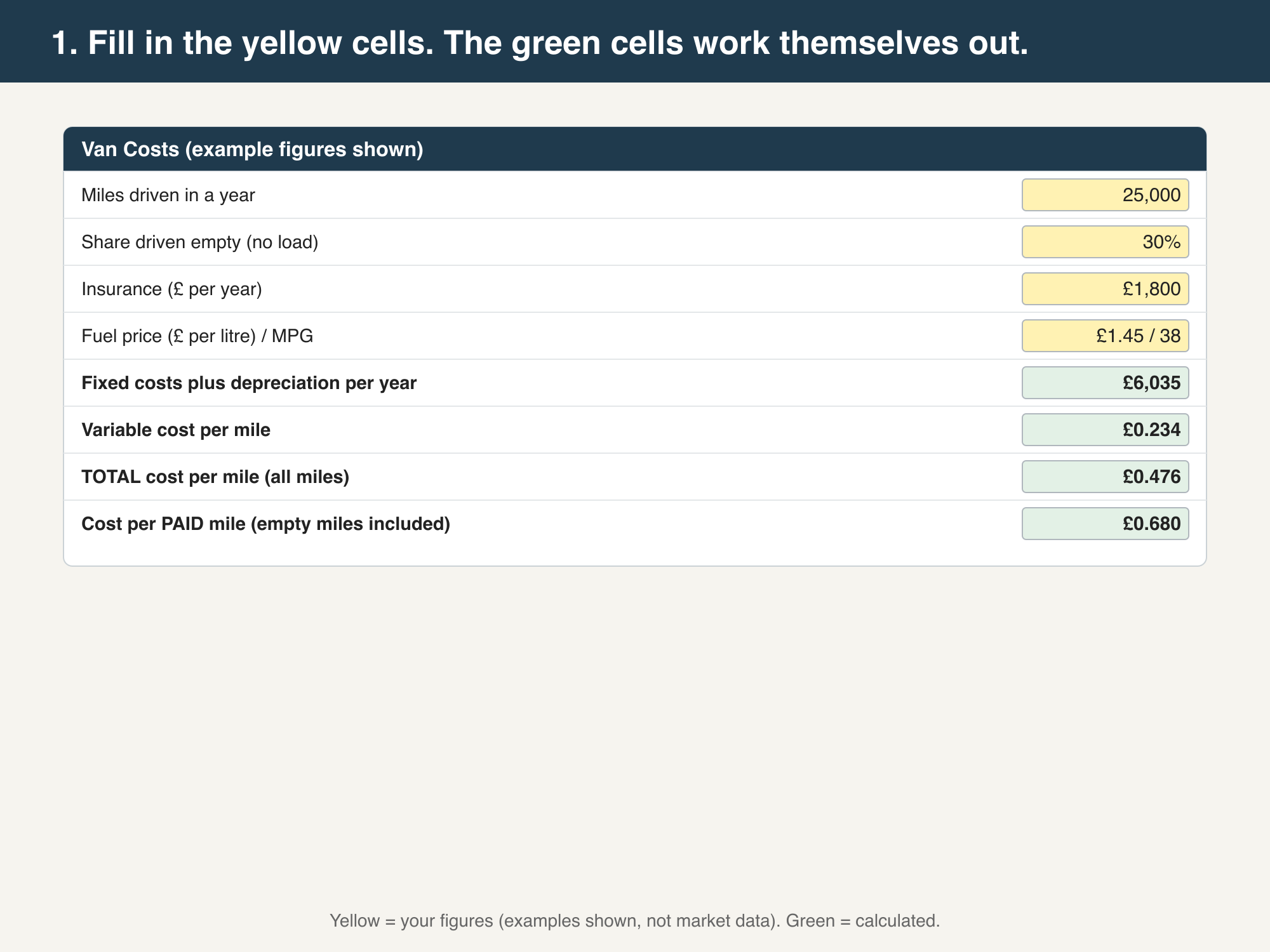
- Fuel, tyres, servicing and other costs per mile
- Fixed costs per year: insurance, vehicle tax, MOT, breakdown cover, finance or lease, depreciation
- Total cost per mile and cost per PAID mile (empty and return miles counted)
- The day rate, hourly rate and per-loaded-mile rate you need to reach the profit you want
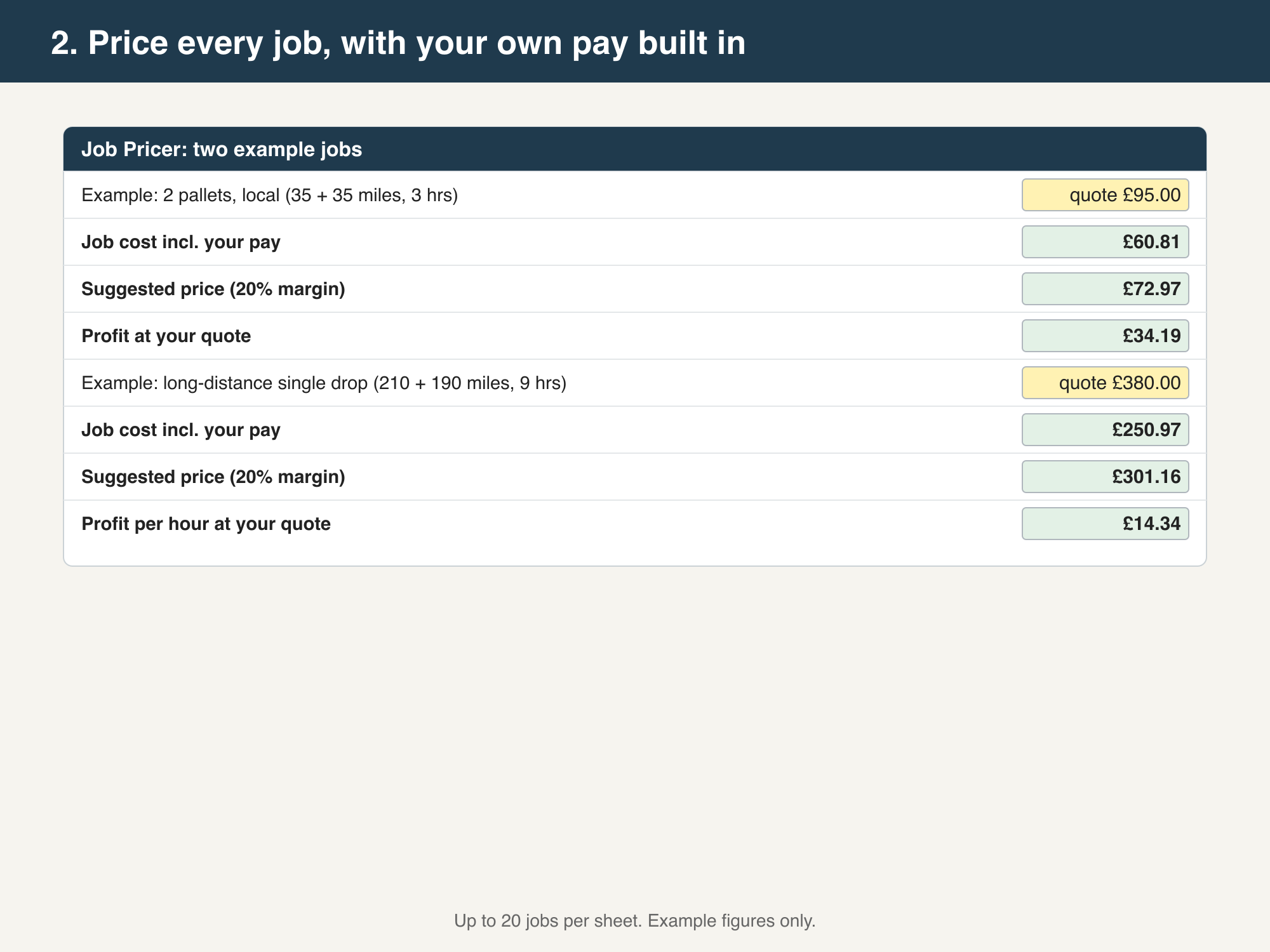
- A job price for each delivery with your own pay built in, plus the profit at the price you quote
- A rough comparison with the HMRC simplified mileage rate

HOW IT WORKS
Yellow cells are for your figures. Green cells are calculated. Example figures are pre-filled so you can see how it works; they are examples only, not market data, so replace them with yours. No macros, no subscription. Standard spreadsheet functions only.

HMRC RATES
On 20 November 2026, GOV.UK showed the simplified mileage rates for cars and goods vehicles as 55p a mile for the first 10,000 miles in 2026-27 and 25p after that (45p before 6 April 2026). The rates sit in cells you can change. Check the current rates on GOV.UK before relying on them.

IMPORTANT
This is a calculator, not tax, accounting or legal advice. The HMRC comparison is rough and does not work out capital allowances, private use or what you can claim. Results are only as good as the figures you enter, and the prices you quote are your own decision. Ask an accountant or check GOV.UK before choosing a tax method.

HOW THIS WAS MADE (AI DISCLOSURE)
Made with the help of AI (Claude, by Anthropic): it wrote the formulas, the instructions and the layout. The formulas were checked automatically against an independent calculation, including zero and edge cases. The listing images were generated from the files' own example figures and illustrate the spreadsheet.

Digital download only. No physical item is sent. Please read the description before buying.
Buy now: £5.99

UK Private Hire Driver Tax Spreadsheet 2026/27: Uber and Bolt Income, Mileage and Expenses Tracker (Excel, Google Sheets)

£5.99

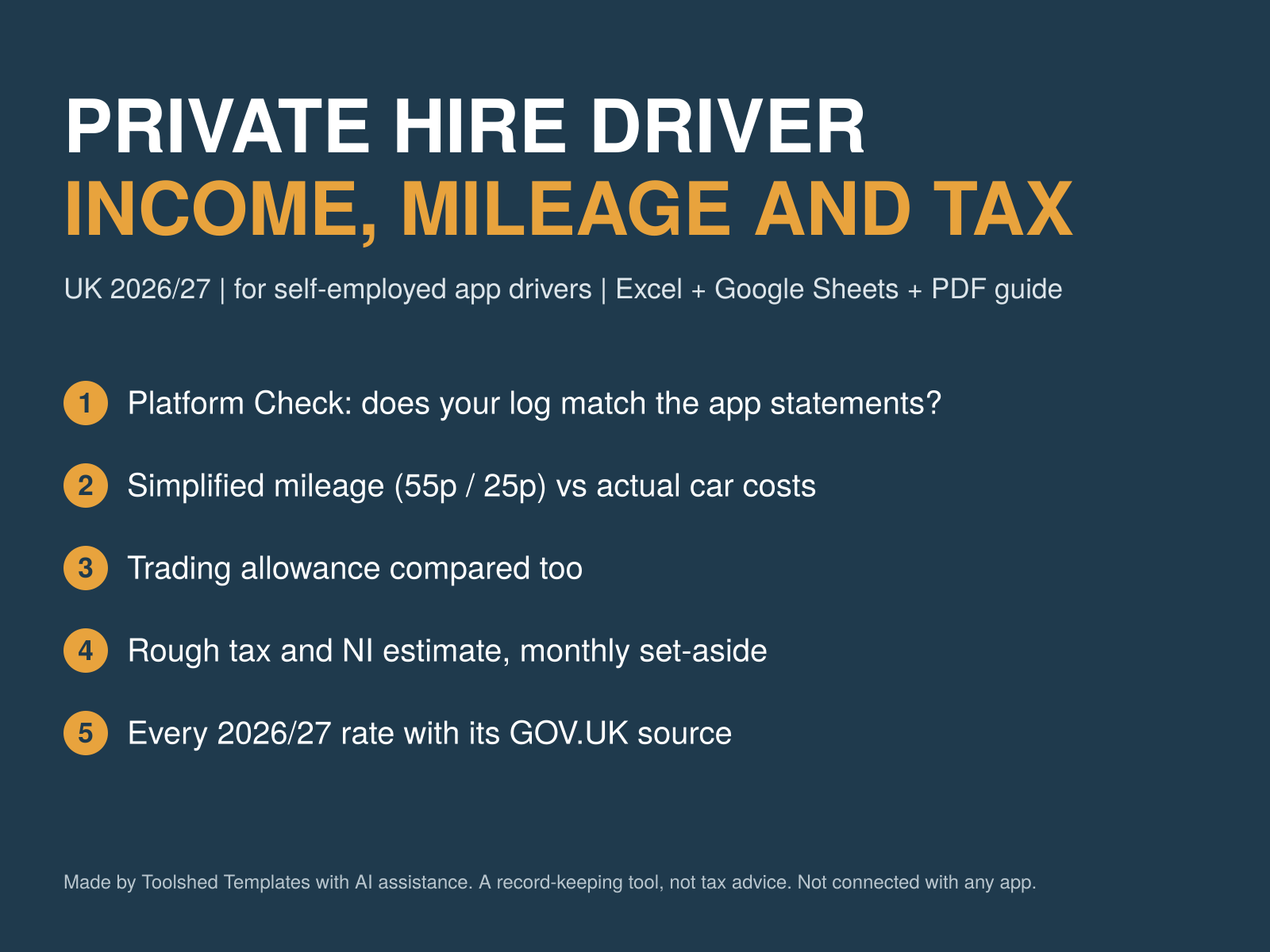
Keep your Uber, Bolt and private hire records in one place for 2026/27, check them against what the apps say, and see which expenses method gives you the lower profit.

For self-employed private hire drivers in England, Wales and Northern Ireland. You type in your own fares, fees, costs and miles. The sheet does the sums.

WHAT YOU GET (instant download, 2 files)
1. Spreadsheet for Excel and Google Sheets, 9 tabs: Start Here, Rates, Categories, Income, Expenses, Mileage, Platform Check, Compare, Summary.
2. PDF guide (4 pages): quick start, what to record and why, rates with their GOV.UK sources, and a printable weekly log.

WHAT IT DOES
- Income by app: gross fares, tips, bonuses and the platform fee, kept separate
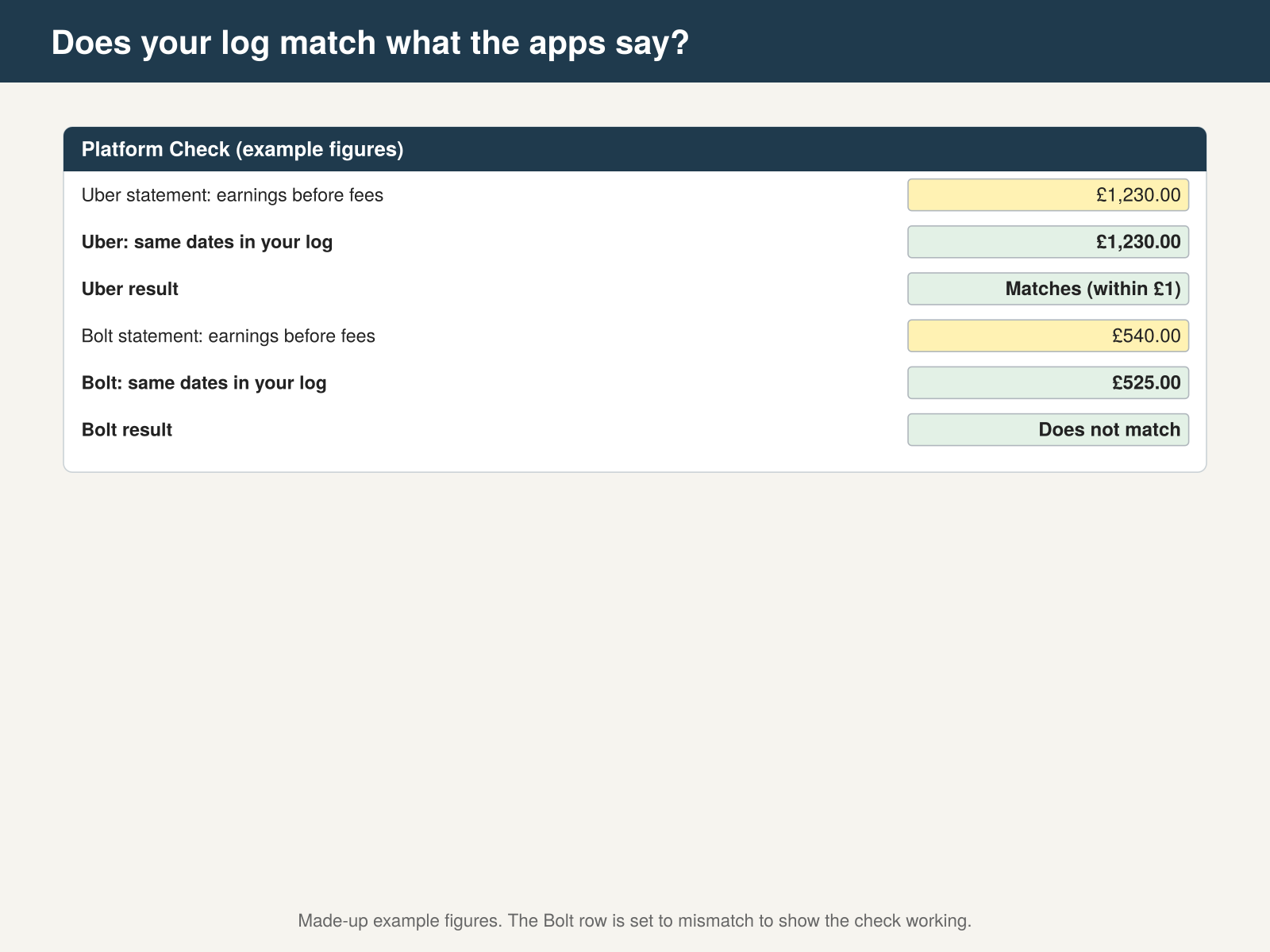
- Platform Check: type each app's statement totals and dates, and it tells you if your log matches for the same dates
- Expenses by category, with a business-use percentage for things like your phone
- Mileage log for business and private miles
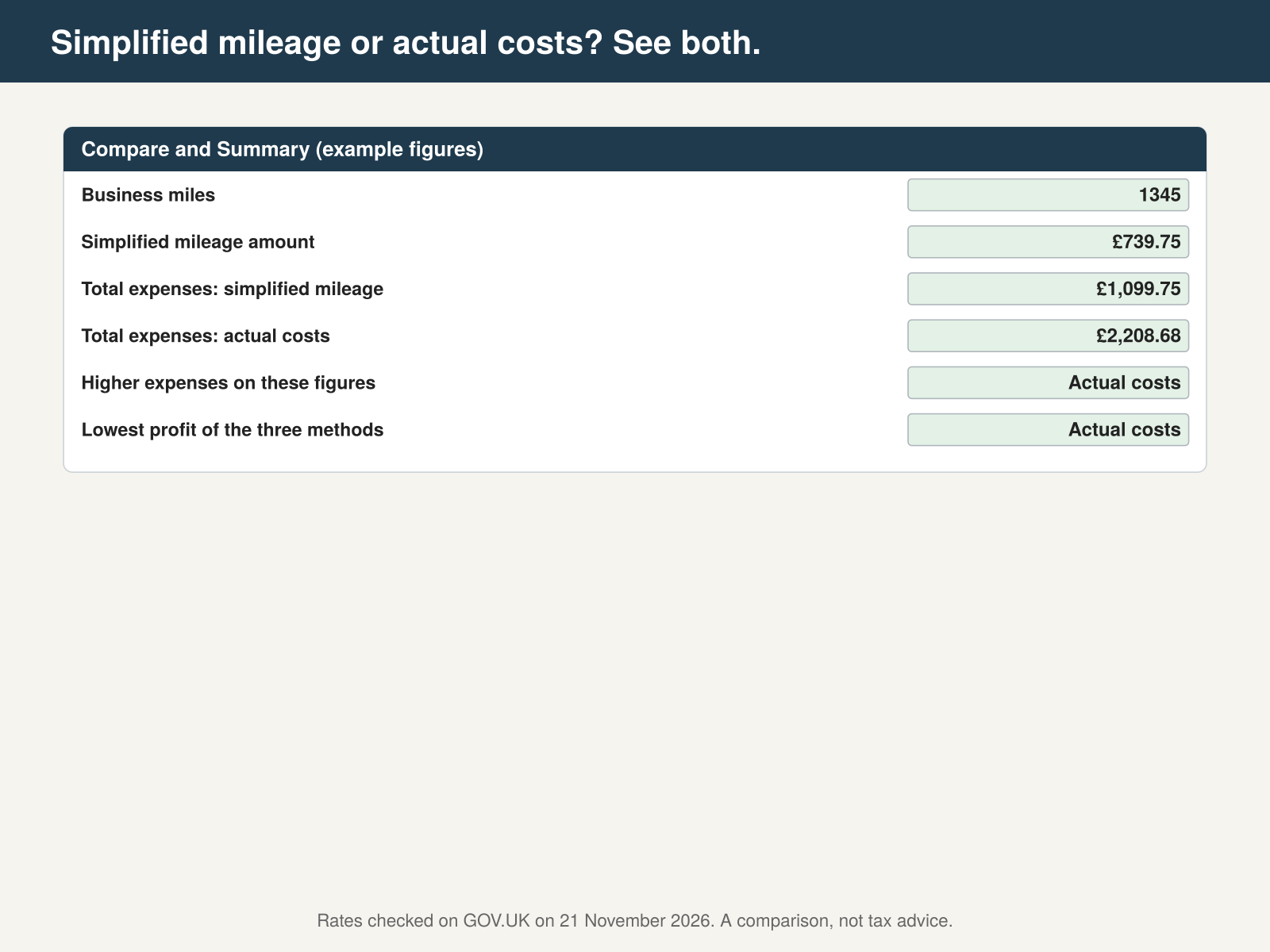
- Compare: simplified mileage (55p for the first 10,000 miles, 25p after, for 2026-27) against your actual car costs
- Summary: profit with simplified mileage, actual costs or the £1,000 trading allowance, the lowest of the three, a rough Income Tax and Class 4 National Insurance estimate, and how much to set aside each month
- Every rate in one Rates tab with its GOV.UK source, so you can update it

HONEST LIMITS
This is a record-keeping tool and a rough guide, not tax, accounting or legal advice. It uses England, Wales and Northern Ireland tax bands, not Scottish ones. It does not work out capital allowances, VAT, payments on account or student loans. GOV.UK leaves three points open, and the sheet says where: whether private hire cars are covered by simplified mileage (GOV.UK names black cabs as excluded but does not mention private hire cars), whether miles between jobs count as business miles, and how platform fees should be shown. Please check current HMRC guidance on GOV.UK, or ask an accountant, before you file.

Rates checked on GOV.UK on 21 November 2026.

Not connected with, or endorsed by, Uber, Bolt, FREENOW or HMRC. App names are used only to say who the sheet is for.

HOW THIS WAS MADE (AI DISCLOSURE)
Made by Toolshed Templates with an AI assistant (Claude, by Anthropic), which wrote the formulas, the wording and the layout. Every formula was tested against a separate calculation, including blank, zero, loss and high-income cases. The images show the spreadsheet's own example figures.

Digital download only. No physical item is sent.

Buy now: £5.99

UK Courier and Owner-Driver Tax Spreadsheet 2026/27: Income, Expenses and Mileage, Mapped to Tax Return Boxes (Excel, Google Sheets)

£5.99

See exactly which tax return box each figure goes in, and whether the mileage allowance or your real van costs gives you the lower profit.

For self-employed couriers, multi-drop and owner-drivers in a van or car in England, Wales and Northern Ireland. You type in your own pay, costs and miles. The sheet does the sums.

WHAT YOU GET (instant download, 2 files)
1. Spreadsheet for Excel and Google Sheets, 10 tabs: Start Here, Rates, Categories, Income, Expenses, Mileage, Platform Check, Compare, Summary, Tax Return Boxes.
2. PDF guide (4 pages): quick start, what to record and why, rates with their GOV.UK sources, and a printable weekly log.

WHAT IT DOES
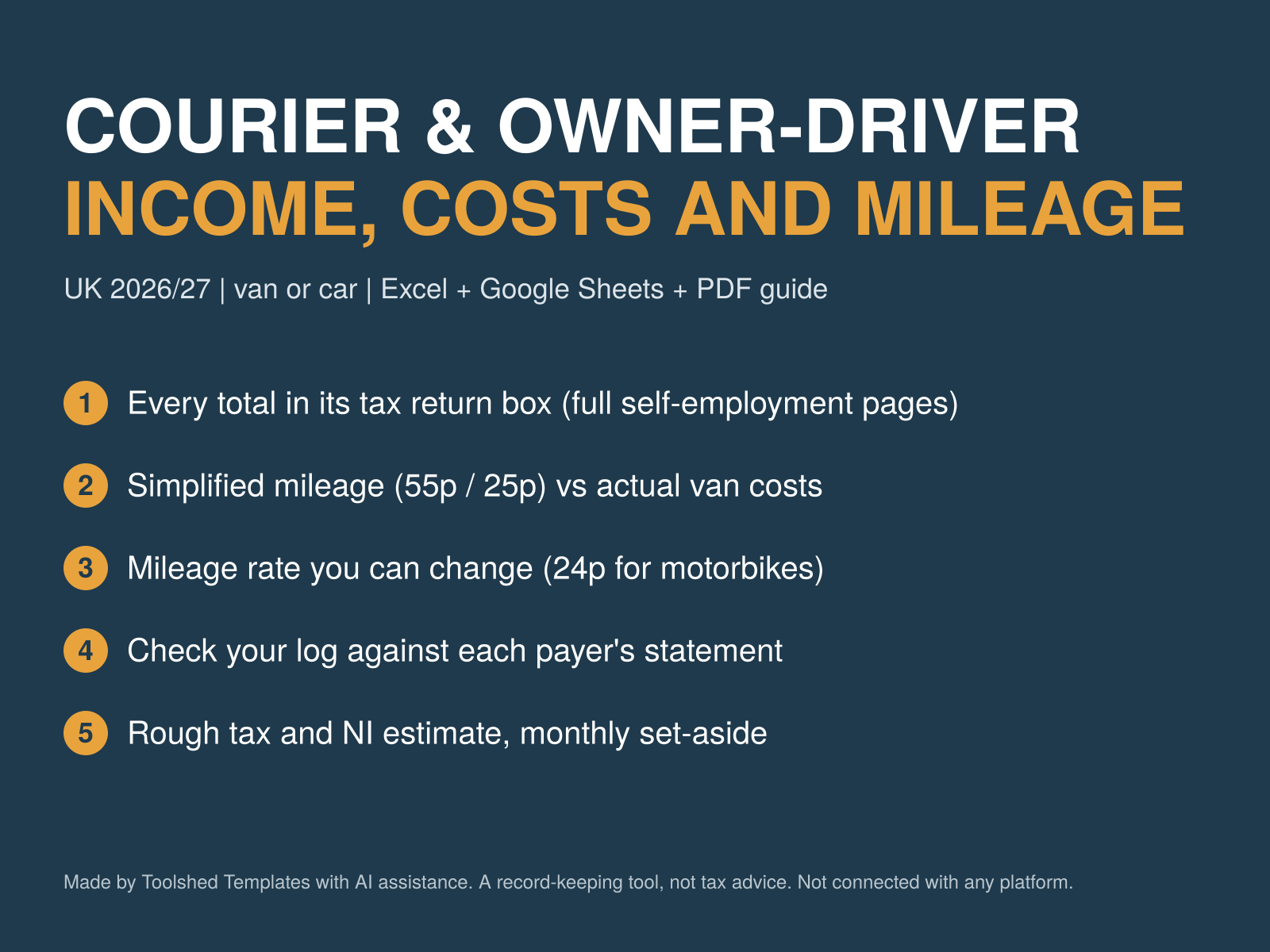
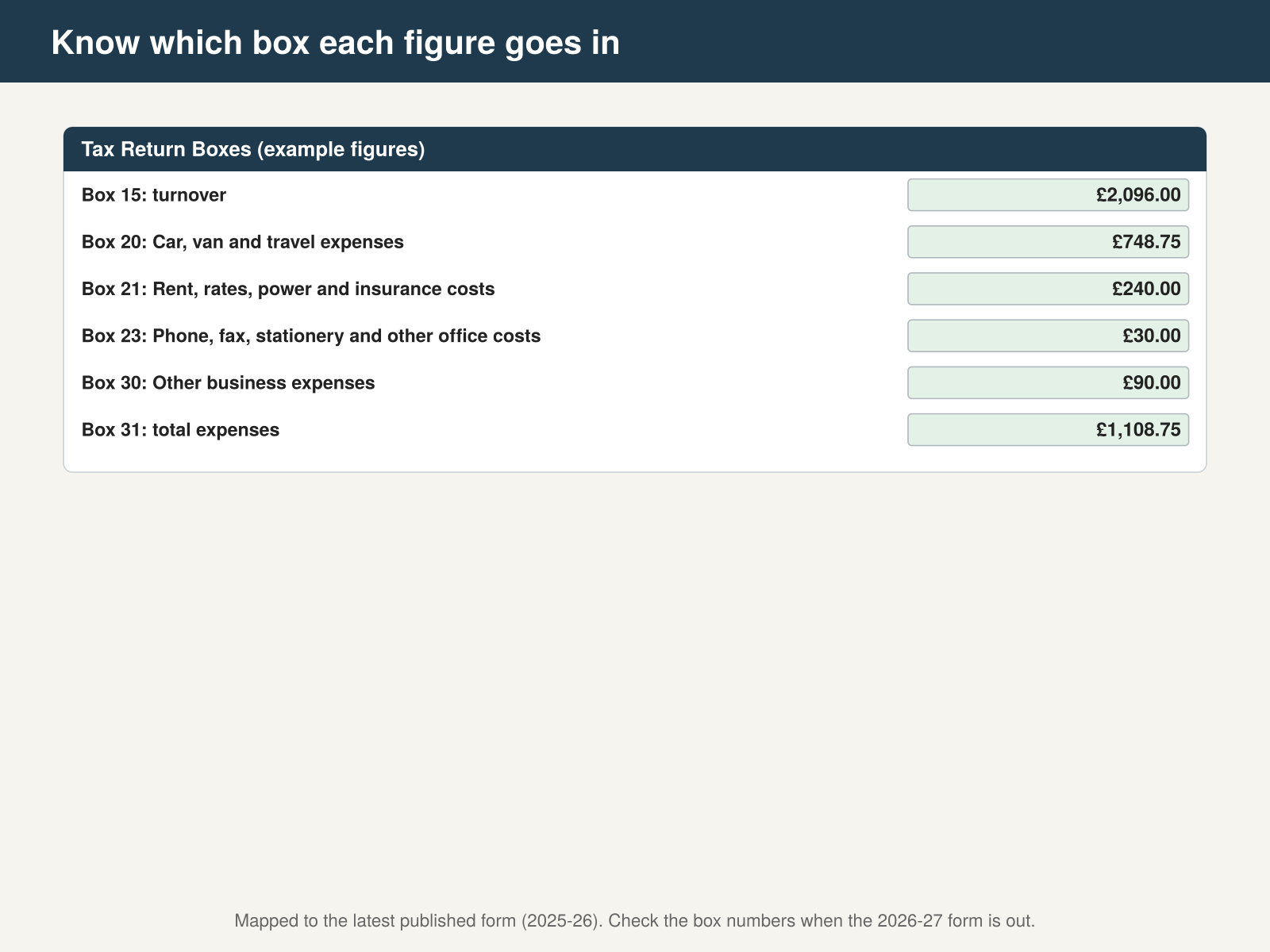
- Tax Return Boxes: every total lands in its box on the full self-employment pages, with the private-use part split into its own box
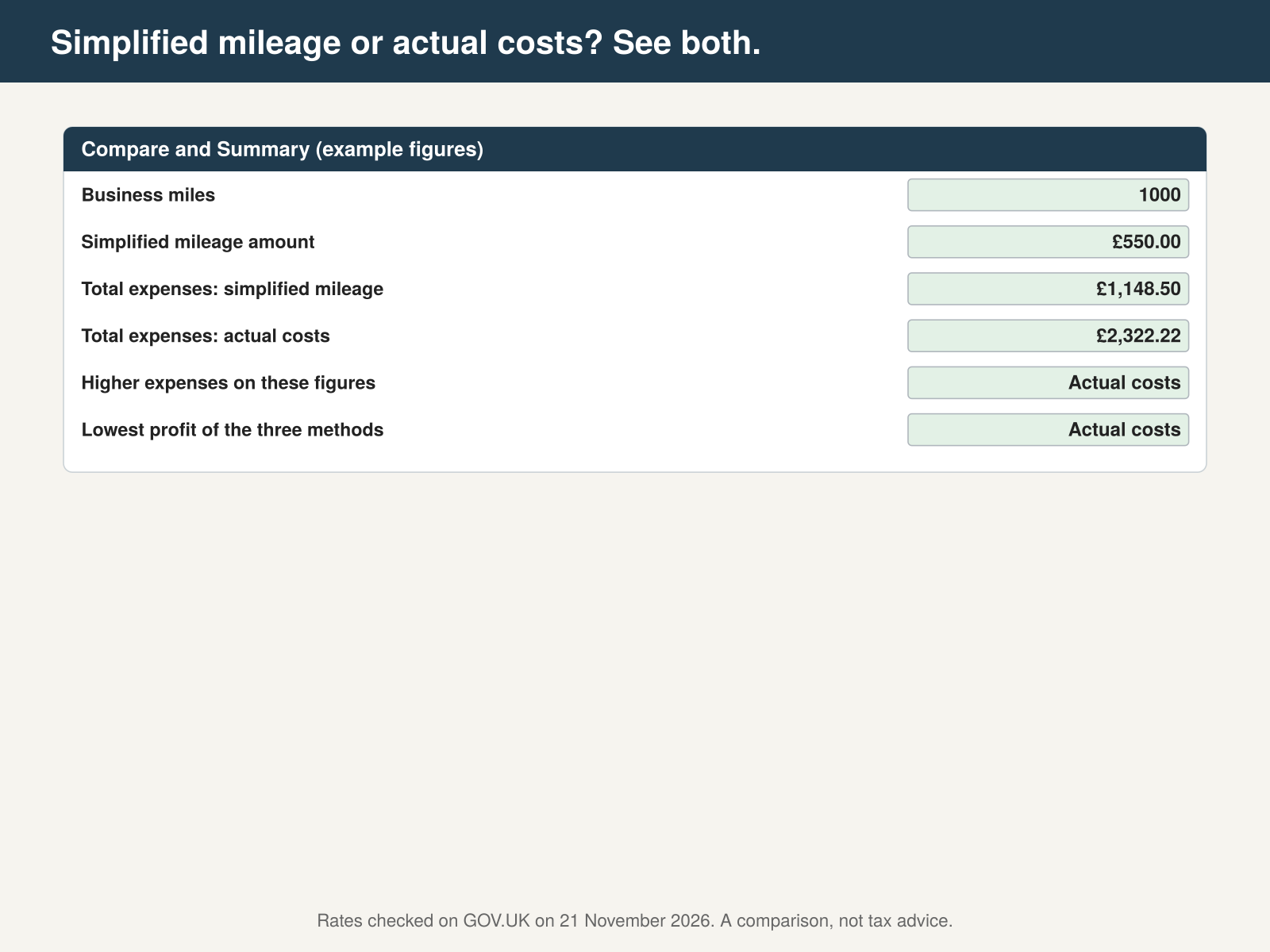
- Compare: simplified mileage (55p for the first 10,000 business miles, 25p after, for 2026-27) against your actual van or car costs
- Summary: profit with simplified mileage, actual costs or the £1,000 trading allowance, the lowest of the three, a rough Income Tax and Class 4 National Insurance estimate, and how much to set aside each month
- Income by payer: gross pay, tips, bonuses and fees taken off, kept separate
- Statement check: type a platform's or depot's statement totals and dates, and it tells you if your log matches
- Expenses by category, with a business-use percentage for things like your phone
- Mileage log for business and private miles
- The mileage rate is a cell you can change (for example 24p for a motorbike), and every rate shows its GOV.UK source

HONEST LIMITS
This is a record-keeping tool and a rough guide, not tax, accounting or legal advice. HMRC has not published the 2026-27 tax return yet, so the boxes follow the latest published form (2025-26); some box numbers are confirmed on an HMRC helpsheet and the rest are marked "check it on the form". It uses England, Wales and Northern Ireland tax bands, not Scottish ones. It does not work out capital allowances, VAT, payments on account or student loans. Please check current HMRC guidance on GOV.UK, or ask an accountant, before you file.

Rates checked on GOV.UK on 21 November 2026.

Not connected with, or endorsed by, Amazon, Evri, DPD, Yodel, Uber Eats, Deliveroo, Just Eat, Stuart or HMRC. Names are used only to say who the sheet is for.

HOW THIS WAS MADE (AI DISCLOSURE)
Made by Toolshed Templates with an AI assistant (Claude, by Anthropic), which wrote the formulas, the wording and the layout. Every formula was tested against a separate calculation, including blank, zero, loss and high-income cases. The images show the spreadsheet's own example figures.

Digital download only. No physical item is sent.

Buy now: £5.99

First Employee Checklist for UK Sole Traders 2027: Employment Rights Act dates, day-one duties, printable PDF

£12.00

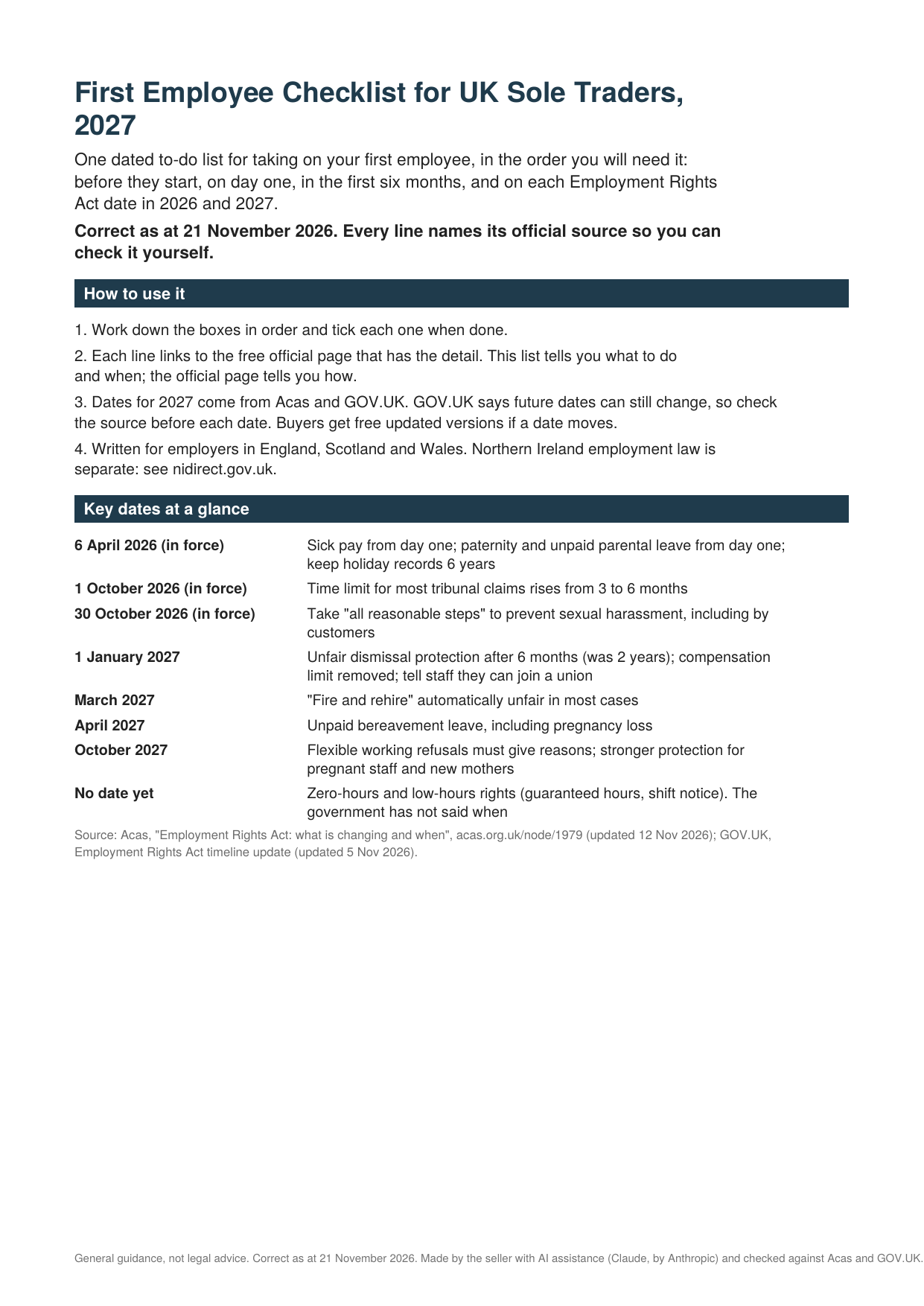
Taking on your first employee? The rules change again on 1 January 2027.

This is one short, dated to-do list that puts everything in the order you need it:

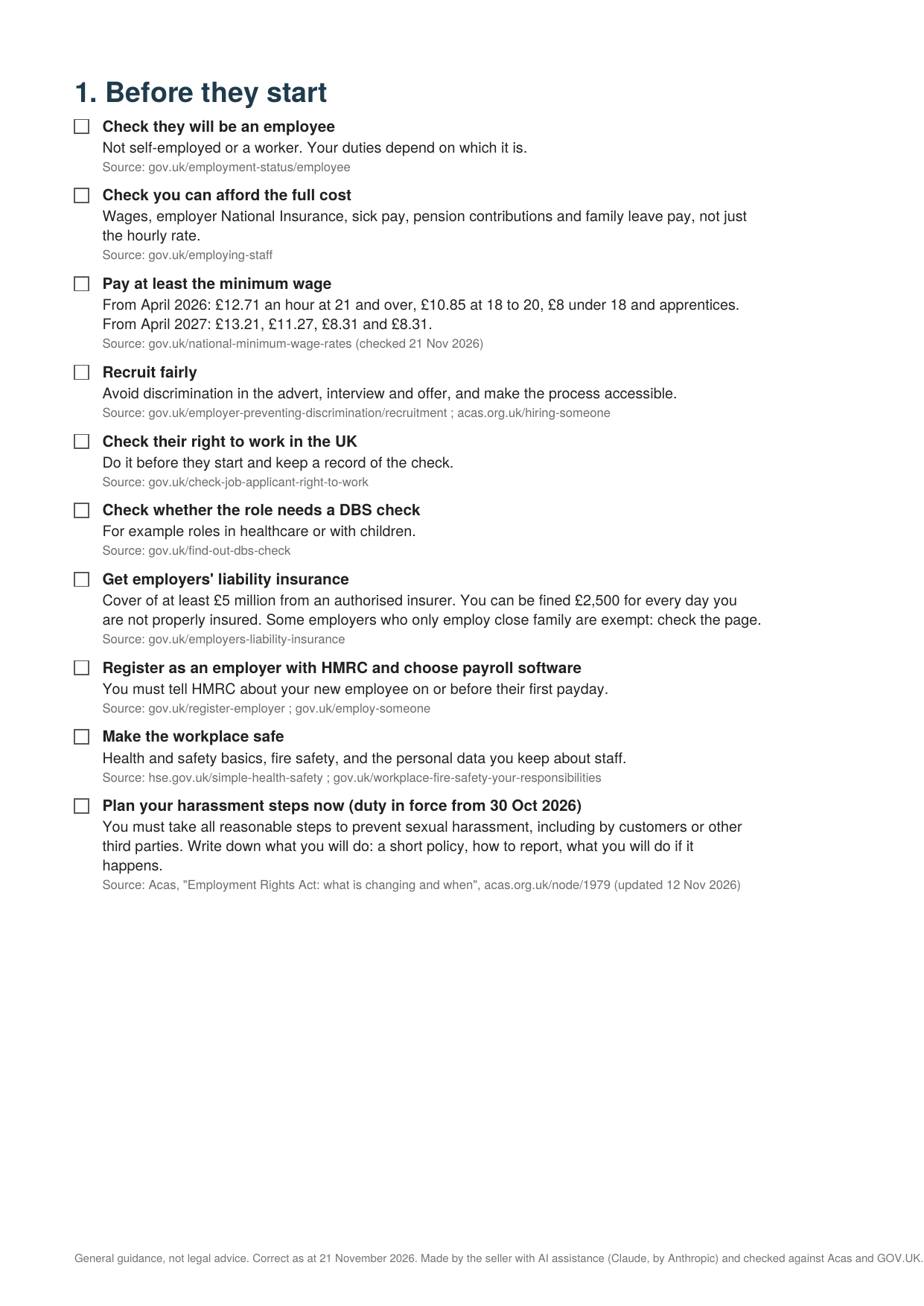
- Before they start: employee or not, real cost, minimum wage, right to work, insurance, registering with HMRC, your harassment steps.
- Day one: the written statement, sick pay from day one, pension, the records to keep, telling staff they can join a union (from 1 January 2027).
- The first six months: why they matter from 1 January 2027, the longer claim window, the March 2027 "fire and rehire" change.
- Dates still to come: April and October 2027, and the zero-hours rights that have no date yet.

Every line names its official source (Acas or GOV.UK) so you can check it yourself, and links to the free official page for the detail. Tick boxes, plain English, 5 A4 pages, prints in black and white.

Correct as at 21 November 2026. Government dates can still move. If a date in the list changes, you get the updated version free.

Who it is for: sole traders and very small businesses in England, Scotland and Wales taking on their first one or two people. Northern Ireland employment law is separate.

What it is not: it is general guidance, not legal advice, and not a contract or policy pack. For a decision about a real person, especially a dismissal, use the free Acas guidance or a qualified adviser.

How it was made: designed by the seller with the help of an AI assistant (Claude, by Anthropic), which helped gather the official sources, draft the wording and lay out the pages. The seller chose the scope and order and checked every date against Acas and GOV.UK.

Not connected with or endorsed by Acas, GOV.UK, HMRC or The Pensions Regulator.

Instant download: one PDF.

Buy now: £12.00

Lost or Damaged Parcel Claim Pack for UK Sellers: who claims, deadlines by carrier, 5 editable letters

£4.99

Refunded a buyer for a lost or damaged parcel? Get your money back from the carrier before the window closes.

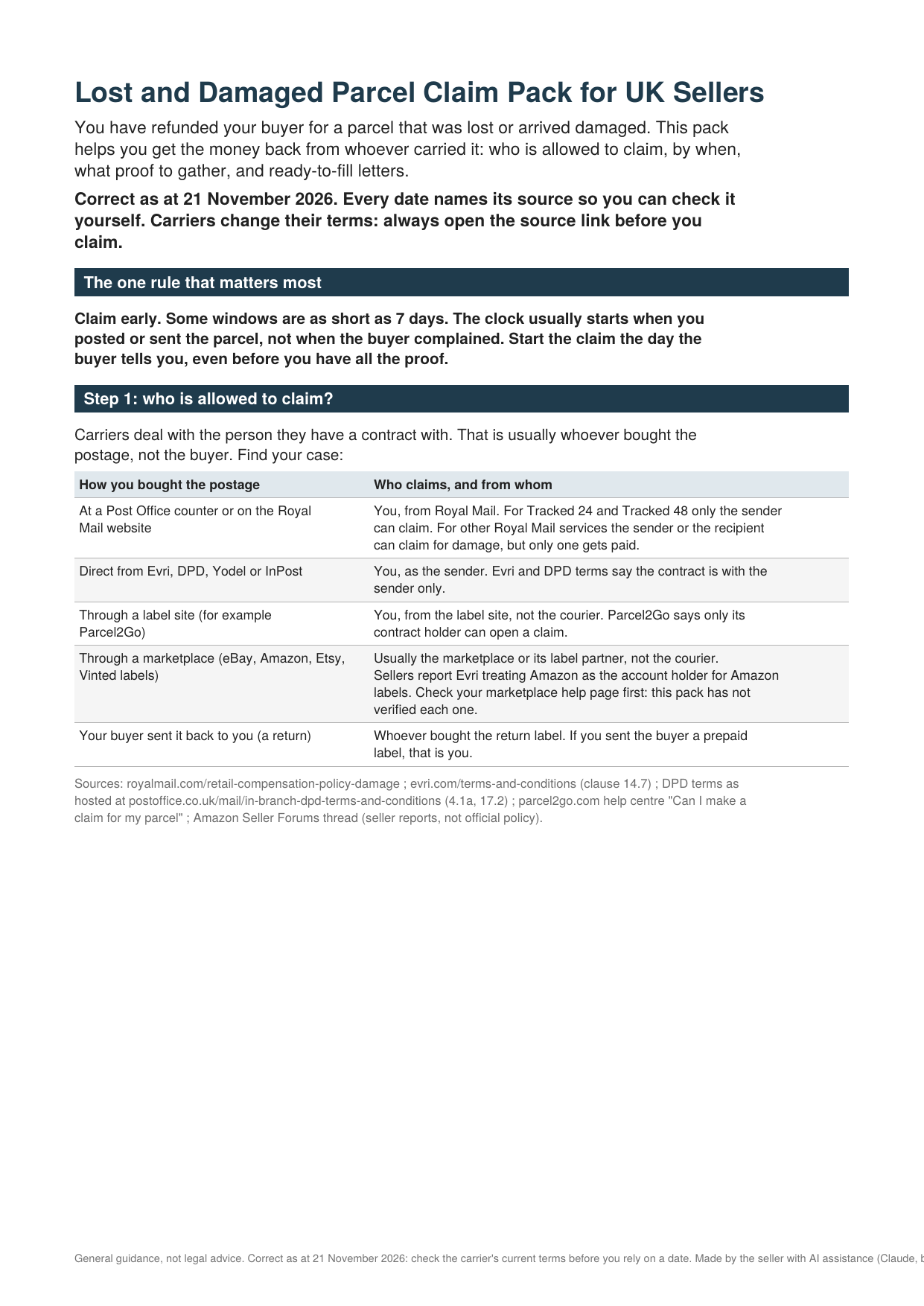
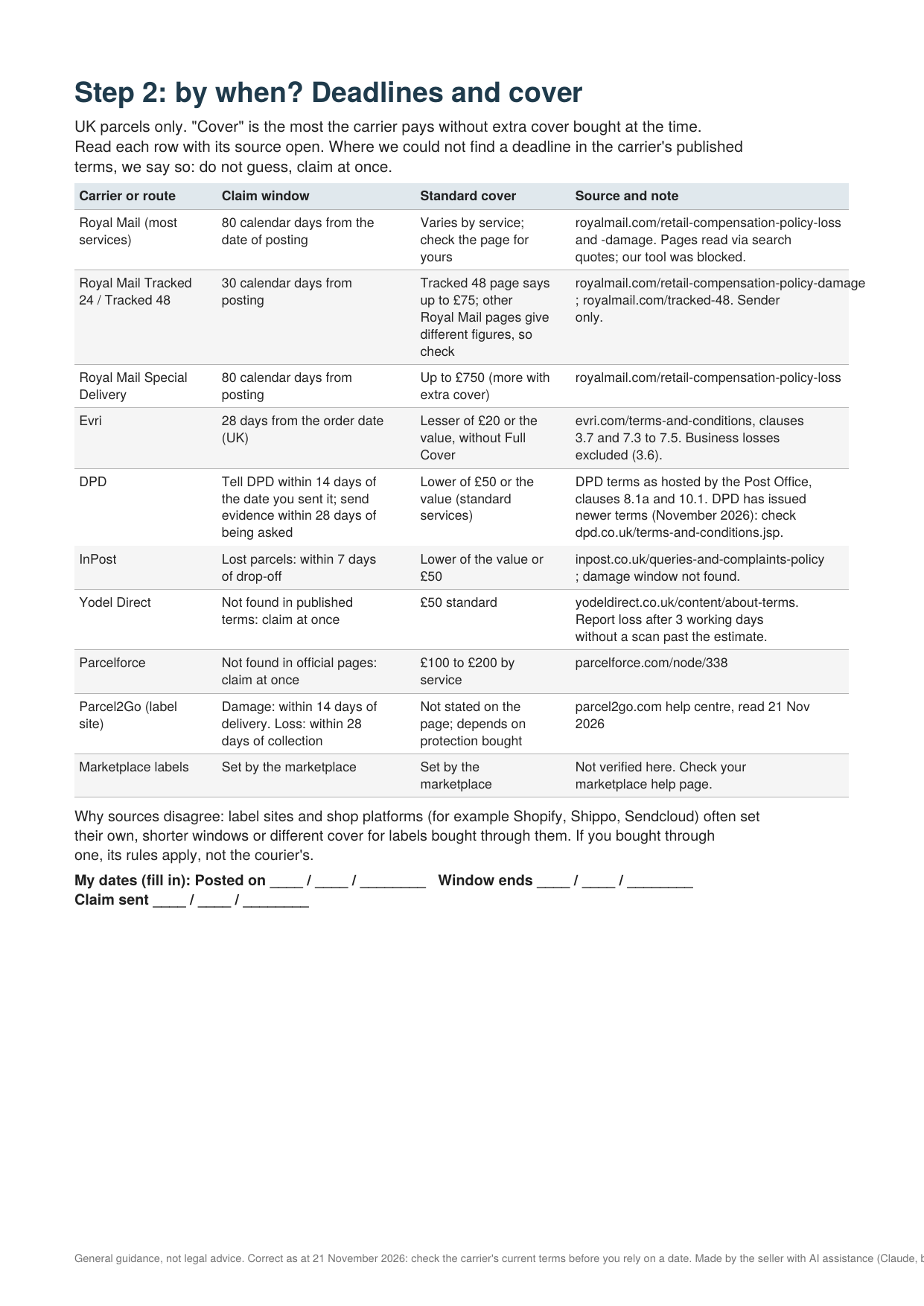
Some claim windows are as short as 7 days, and the right person to claim is not always the courier. This pack puts it all in one place for sellers:

- Who claims: Post Office, direct courier, label site or marketplace label: who you claim from in each case.
- By when: a deadline and cover table for Royal Mail, Evri, DPD, InPost, Yodel, Parcelforce and Parcel2Go, each with its source and the date we checked it.
- The proof: a tick-box evidence checklist, so your claim is not turned down for something missing.
- Five editable letters: lost parcel claim, damaged parcel claim, follow-up, final complaint, and a polite request to your buyer for a non-receipt statement.

4-page PDF plus an editable letters file (opens in Word, Pages, Google Docs or LibreOffice).

Correct as at 21 November 2026. Carriers change their terms; if a date or limit in the pack changes, you get the updated version free.

Who it is for: UK sellers on eBay, Etsy, Vinted, Amazon or their own shop, sending parcels within the UK.

What it is not: general guidance, not legal advice. The carrier's own terms always come first. International parcels are not covered.

How it was made: designed by the seller with the help of an AI assistant (Claude, by Anthropic), which helped gather the carriers' published terms, draft the wording and lay out the pages. The seller chose the scope and format and checked each date against its source.

Not connected with or endorsed by Royal Mail, Evri, DPD, Yodel, InPost, Parcelforce, Parcel2Go or any marketplace.

Instant download: one PDF and one editable letters file.

Buy now: £4.99